Why Marketing Analytics Has Become the Core of Modern Digital Growth
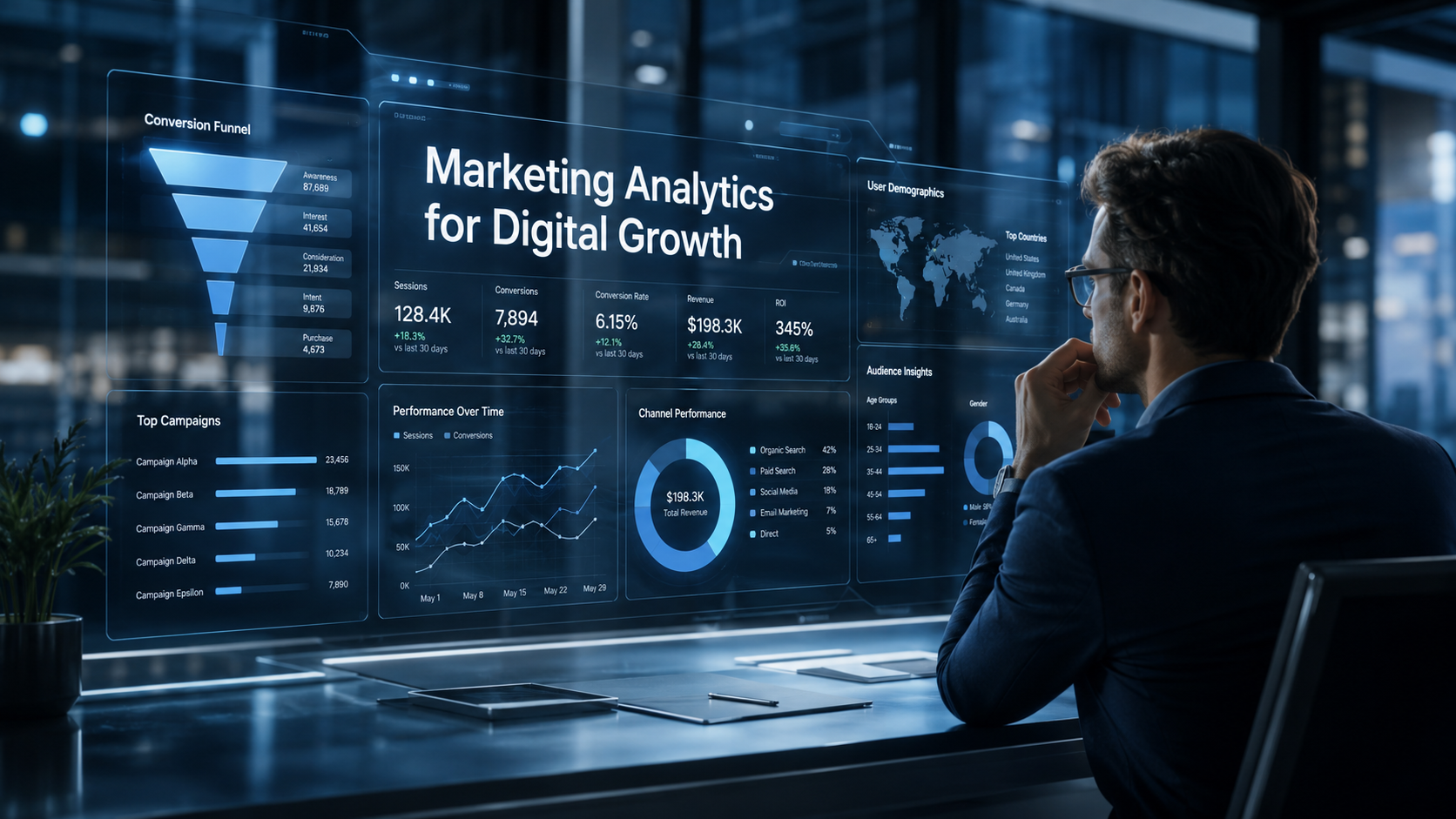
In today’s digital ecosystem, marketing success is no longer defined by how many campaigns a business runs.
It is defined by how accurately those campaigns are measured, interpreted, and optimized.
As businesses scale their digital presence across platforms such as Google, Meta, LinkedIn, and other performance channels, the volume and complexity of data increase significantly. Without a structured analytics approach, marketing decisions quickly become assumption-based rather than insight-driven.
This is why marketing analytics has become a core capability in modern digital marketing.
The Shift from Execution-Focused Marketing to Data-Driven Growth
Traditional digital marketing was primarily focused on execution:
- Running advertisements
- Posting content regularly
- Managing social media channels
- Driving website traffic
While these activities remain important, they are no longer sufficient for sustainable growth.
Modern marketing performance depends on the ability to answer critical business questions such as:
- Which channel produces the highest-quality leads?
- What is the true cost per acquisition?
- Which campaigns actually contribute to revenue?
- Where do users drop off in the conversion funnel?
- How can conversion rates be systematically improved?
Without analytics, these questions remain unanswered, and marketing becomes reactive rather than strategic.
Why Most Digital Marketing Efforts Fail to Scale
Many businesses actively invest in digital marketing but struggle to achieve consistent or scalable results.
The most common reasons include:
- Incomplete or inaccurate conversion tracking
- Lack of structured data collection systems
- No unified reporting framework
- Dependence on vanity metrics (likes, impressions, reach)
- Limited understanding of customer behavior
- Poor integration between marketing platforms
As a result, marketing teams often optimize for visibility instead of profitability.
This leads to a situation where campaigns may appear successful on the surface but fail to generate meaningful business outcomes.
The Role of Marketing Analytics in Modern Businesses
Marketing analytics bridges the gap between marketing activity and business outcomes.
It transforms marketing from:
“We are running campaigns”
into
“We are generating measurable business growth”
A well-structured analytics system enables organizations to:
- Track the full customer journey
- Measure campaign performance accurately
- Identify high-performing traffic sources
- Eliminate wasted advertising spend
- Improve conversion rates systematically
- Forecast revenue with greater accuracy
In essence, marketing analytics turns marketing into a performance-driven growth system.
Core Components of a Modern Marketing Analytics System
High-performing organizations typically build analytics systems across multiple layers:
1. Tracking Infrastructure
Implementation of tools such as Google Tag Manager, GA4, Meta Pixel, and event tracking systems to capture user behavior accurately.
2. Conversion Tracking
Defining and measuring meaningful business actions such as leads, purchases, sign-ups, bookings, or inquiries.
3. Funnel Analysis
Understanding how users move from awareness to conversion and identifying drop-off points within the journey.
4. Attribution Modeling
Identifying which channels and campaigns contribute most to conversions and revenue generation.
5. Reporting Systems
Creating dashboards and reports that translate raw data into actionable insights for decision-making.
6. Optimization Frameworks
Continuously improving marketing performance based on data rather than assumptions or intuition.
Why Businesses Without Analytics Struggle to Grow
Without proper analytics systems, businesses often face:
- Inefficient marketing spend
- Unclear campaign performance
- Inability to scale successful campaigns
- Poor understanding of customer behavior
- Weak decision-making processes
- Inconsistent business growth
Over time, this creates a competitive disadvantage, especially in markets where data-driven competitors operate more efficiently.
The Competitive Advantage of Analytics-Driven Marketing
Organizations that fully integrate marketing analytics into their operations gain a strong competitive advantage.
They are able to:
- Scale profitable campaigns faster
- Reduce customer acquisition costs
- Improve return on marketing investment
- Make faster and more accurate decisions
- Adapt quickly to market changes
- Build predictable growth systems
As a result, marketing becomes not just a cost center, but a measurable revenue driver.
Marketing Analytics as a Career-Defining Skill
As digital marketing evolves, analytics has become one of the most in-demand skill sets in the industry.
Professionals with strong marketing analytics capabilities are increasingly required for roles such as:
- Performance Marketing Specialists
- Digital Marketing Managers
- Growth Strategists
- Marketing Analysts
- E-commerce Marketers
- Lead Generation Experts
The ability to connect marketing data with business outcomes is now a key differentiator in career growth and organizational success.
Final Thoughts
Marketing is no longer defined by activity.
It is defined by clarity, measurement, and optimization.
Without analytics, marketing remains guesswork.
With analytics, marketing becomes a structured system for predictable growth.
As digital competition continues to increase, businesses that invest in marketing analytics will consistently outperform those that rely on intuition or fragmented reporting systems.
In modern digital marketing, data is not optional.
It is the foundation of sustainable growth.
Turning Marketing Data Into Real Business Growth
Understanding marketing analytics is the first step.
The real value comes from applying it to build structured, performance-driven marketing systems that consistently improve results over time.
Businesses that master analytics are able to move beyond guesswork and make confident, data-backed decisions that directly influence growth, efficiency, and profitability.
If you want to develop practical expertise in building tracking systems, analyzing campaign performance, and optimizing digital marketing outcomes, explore advanced-level learning in structured marketing analytics.
Learn more: https://apidm.asia/advanced-performance-marketing-and-analytics-program/
Because in modern marketing, data is not just information – it is the foundation of growth.
Related articles