Modern Digital Media Planning: Moving from Fixed Budgets to Dynamic Strategy
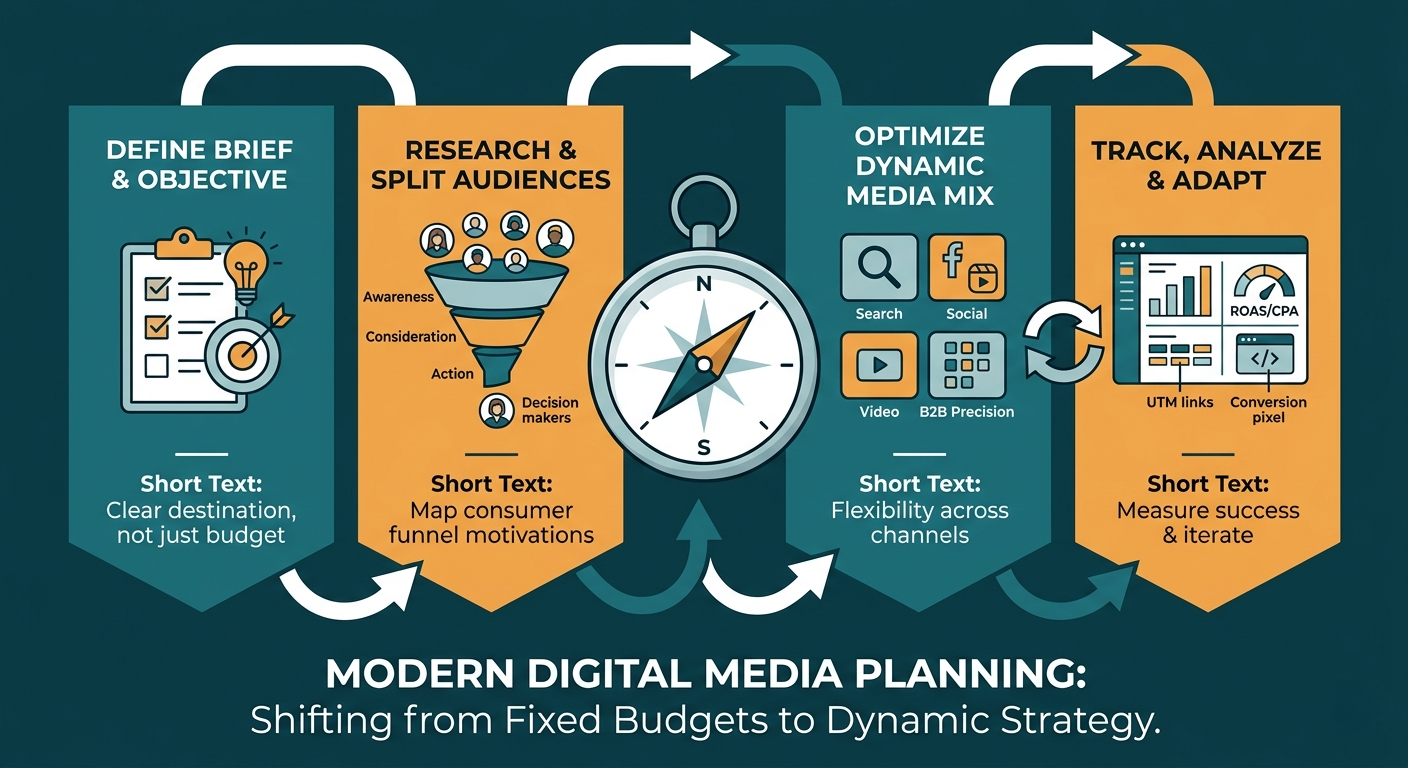
Have you ever looked at a freshly approved media plan and questioned if it will actually deliver business results?
The spreadsheet looks perfect. The budget for the new financial year is neatly sliced into fixed platform buckets, the target segments are locked in, and the brand managers are satisfied because everything is set to spend exactly 100% of the allocation.
However, planning with such rigid structures ignores how modern digital ecosystems actually operate.
In an era dominated by automated ad platforms and real-time machine learning, traditional, static media planning is no longer effective. If a campaign’s success is measured purely by whether the allocated budget was fully spent, the strategy is missing the point.
To drive real performance today, businesses must move away from rigid tracking and transition into flexible Digital Planning. Let’s look at how to structure a modern media strategy that balances guidance with room to optimize.
1. The Shift from Fixed Allocations to Platform Signals
A few years ago, media planning followed a predictable routine. You defined a strict target criteria, locked in a platform budget, and spent it evenly regardless of daily performance fluctuations.
Today, that approach fails. If you build a Meta audience during planning, it might show a potential reach of one million users. By the time the campaign runs, that number shifts.
Modern platforms rely heavily on automated systems like Advantage+ and advanced machine learning optimizations. We no longer dictate exact, rigid parameters to ad platforms; we provide data signals. The platform then expands, tests, and finds the converting user based on real-time behavior.
[Traditional Planning] ---> Fixed Budgets ---> Static Targeting ---> Metric: 100% Budget Spent
[Modern Digital Planning] ---> Flexible Budgets --> Audience Signals ---> Metric: Business Outcomes (ROAS/CPA)
Tying the hands of your media buyer with rigid channel limitations prevents them from shifting capital to what is working right now. For top-of-funnel awareness campaigns, a fixed budget makes sense because you are chasing clear reach and frequency metrics. But for sales and action-driven performance campaigns? Flexibility with proper guardrails is your only protection against wasted ad spend.
📺 Want a deeper look at this shift? Watch this in-depth panel discussion on Modern Digital Media Planning Strategy on YouTube to hear experts break down channel selection, budgets, and the evolution of the modern brief.
2. It All Starts with a Flawless Campaign Brief
A digital media planner is only as good as the raw information they receive. Yet, too many brand briefs focus heavily on execution channels (demanding specific platforms) while omitting foundational business context.
A high-performance brief must clearly define the business objectives without dictating how the planner builds the technical machine.
What a Functional Brief Must Contain:
-
The Core Business Objective: Are we driving brand recall for a new product variation, or are we hunting for immediate e-commerce subscriptions?
-
Target Audience Reality: Move past basic demographics. Planners need psychological triggers, behaviors, and regional buying power considerations.
-
Clear Success KPIs & Measurement Framework: Define upfront how success will be measured (e.g., brand lift studies vs. strict cost-per-acquisition).
-
Historical Data Strategy: How will the data from this campaign (like a seasonal New Year, Mother’s Day, or Black Friday rush) be captured and stored to optimize the next seasonal event?
The Planner’s Rule: A brand brief should specify the destination (the business outcome), while the media planner maps the route (the channel mix).
3. Sophisticated Audience Mapping Across the Funnel
Audience research shouldn’t just look at age brackets; it has to map directly to the buyer’s mindset across the consumer funnel.
Consider a practical example: a premium children’s school bag brand launching a cartoon-character series.
[Top of Funnel: Awareness] ---> Target: The Child ---> Visual Video Storytelling (TikTok / Reels)
[Bottom of Funnel: Action] ---> Target: The Parent ---> Logic, Durability & Value Messaging
-
Top of Funnel (Awareness): The target audience is the child. They need high-impact, visual video storytelling on platforms like TikTok or Reels to drive peer word-of-mouth momentum.
-
Bottom of Funnel (Action): The decision-maker and buyer is the parent. They look for durability, spinal support, and pricing value.
If your audience research doesn’t segment your targeting and creative strategies to hit both motivations cleanly, your media plan will miss premium buyers.
4. Building an Uncluttered Digital Media Mix
Overcomplicating the digital ecosystem is a common trap. Launching one dedicated campaign for awareness, a separate isolated campaign for traffic, and a tiny, hyper-specific third campaign for retargeting often hurts performance.
In the modern landscape, micro-segmentation ruins platform learning. Consolidating your data and feeding your main business-as-usual (BAU) campaigns clean, first-party data signals yields vastly better efficiency than fragmenting your budget in too many directions.
When choosing your channels based on your audience research, match the platform to consumer intent:
| Channel Type | Platform Examples | Primary Strategic Role |
| High Intent | Google Search | Capturing active, immediate buyers |
| Interest & Behavior | Meta (Facebook & Instagram) | Demand generation, lookalike scaling |
| Visual Storytelling | TikTok, Instagram Reels, YouTube | Brand narrative, emotional engagement |
| High-Value B2B / C-Suite | Precision professional targeting (e.g., Senior Mid-level Executives, Accountants) | |
| Scale & Mass Reach | Programmatic (DV360, Connected TV) | Inventory scaling outside standard ad networks |
Do not ignore direct media placements either. True media planning balances automated buying with direct alignment on highly trusted industry publications or native contextual networks.
5. The Limited Budget Trap: Focus Over Fragmentation
Let’s look at a scenario that media planners see all too often. A brand requests a presence on Google Search, YouTube Pre-Rolls, Instagram Reels, and LinkedIn, but presents a total budget of $10 a day.
When you spread a limited budget across multiple platforms, no single platform receives enough data to exit its learning phase. You end up paying premium CPMs for zero conversion outcomes.
If your budget is modest, narrow your focus ruthlessly. Pick your single highest-converting channel, master it, and expand only when you have maximized its return.
6. Execution, Tracking, and Technical Guardrails
A brilliant creative strategy means nothing if the underlying analytics engine is broken. Before a single dollar is deployed, ensure your digital structure contains these non-negotiable optimization steps:
-
Robust Tracking: Deeply embedded pixels, Server-Side Conversions API setups, and disciplined UTM parameter structures for flawless attribution.
-
Creative Strategy Rotations: Pre-plan your A/B testing frameworks, formatting variations (9:16 vertical vs. 1:1 square), and creative rotation cycles to beat ad fatigue.
-
Optimization Windows: Give the platforms breathing room. Avoid changing structural settings 24 hours after launch. Let the algorithm stabilize and learn before making adjustments.
-
Transparent Reporting & Terminologies: Align all stakeholders on the critical business metrics that matter—shifting the conversation away from superficial vanity metrics to clear CPM, CPC, CPL, and ROAS realities.
Strategic Takeaway
Modern digital media planning isn’t a static checklist or a rigid spreadsheet to spend blindly. It is an active ecosystem that requires strategic alignment, clean technical signals, and the professional flexibility to shift direction based on clear data insights.
To build true competency in this space, teams must stop treating digital media execution like a routine task and instead develop the practical skills required to engineer plans that convert.
Related articles